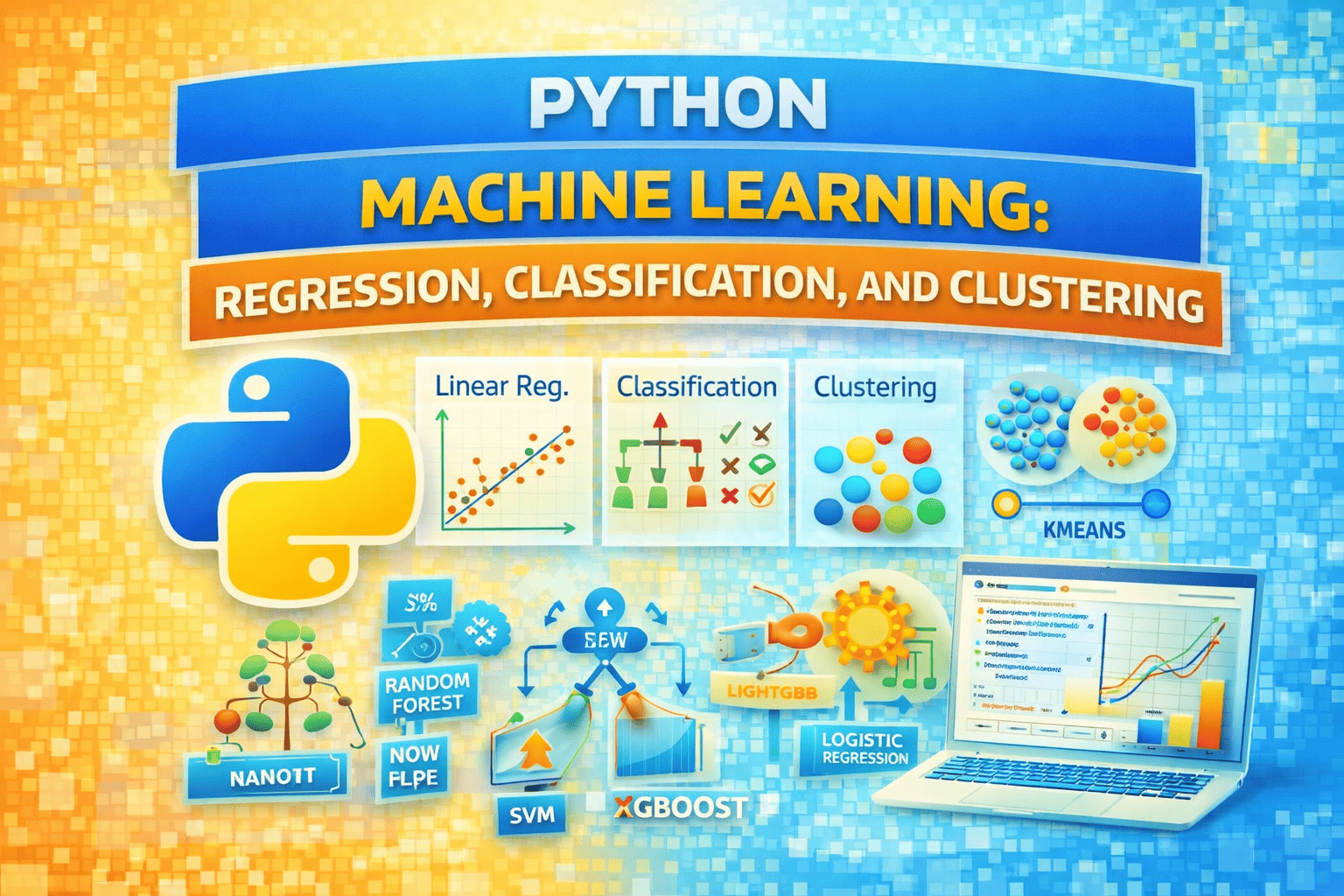
Python Machine Learning: Regression, Classification, and Clustering

By Progya Categories: ChatGPT, Python
Share
Share Course
Page Link
Share On Social Media

About Course

Learn how to build, apply, and understand some of the most widely used machine learning models in Python for regression, classification, and clustering.

This course is designed to help you move from data preparation into actual machine learning model building. Instead of only learning theory, you will work with practical machine learning algorithms used in real-world business, finance, marketing, customer analytics, and predictive modeling.

You will learn how regression models can predict numeric outcomes, how classification models can predict categories, and how clustering models can identify hidden groups inside data. You will also learn how to build these models step by step in Python, making the entire machine learning process much easier to understand.

By the end of this course, you will be able to confidently choose, build, and apply machine learning models for different types of problems, making you ready for projects in data science, machine learning, predictive analytics, and business intelligence.

Show More

What Will You Learn?

  • Build linear regression models to predict continuous outcomes such as sales, profit, customer spending, or house prices
  • Use decision tree regression models to capture more complex relationships in data that linear regression cannot explain properly
  • Build random forest regression models to improve prediction accuracy and reduce the risk of overfitting
  • Apply support vector regression models to solve more advanced prediction problems where relationships between variables are not straightforward
  • Understand how XGBoost regression works and why it is considered one of the most powerful algorithms for prediction tasks
  • Build logistic regression models to predict categories such as yes or no, approved or rejected, churn or no churn, and fraud or non-fraud
  • Use decision tree classification models to create easy-to-understand prediction systems with branching logic
  • Apply random forest classification models to improve classification accuracy and reduce instability in predictions
  • Build K Nearest Neighbours classification models to classify data points based on similarity with nearby observations
  • Learn how LightGBM classification models work and why they are widely used in high-performance machine learning applications
  • Build KMeans clustering models to identify hidden groups and patterns in datasets without needing predefined labels
  • Understand the strengths and weaknesses of different machine learning algorithms so you can make smarter model choices
  • Gain practical experience by building every model in Python instead of only learning theoretical concepts
  • Develop the confidence to work on real-world machine learning projects related to customer segmentation, sales forecasting, fraud detection, churn prediction, and business analytics
  • Learn how to move from raw data to actual prediction and decision-making models in a structured way

Course Content

Hands-on Machine Learning Part 1 – Regression

  • Linear regression ML model
    18:18
  • Decision Tree regression ML model
    08:08
  • Random Forest regression ML model
    08:04
  • Support Vector regression ML model
    06:26
  • XGBoost regression ML model
    07:37

Hands-on Machine Learning Part 2 – Classification

Hands-on Machine Learning Part 3 – Clustering

Earn a certificate of your expertise!

Add this certificate to your resume to demonstrate your skills & increase your chances of getting noticed.
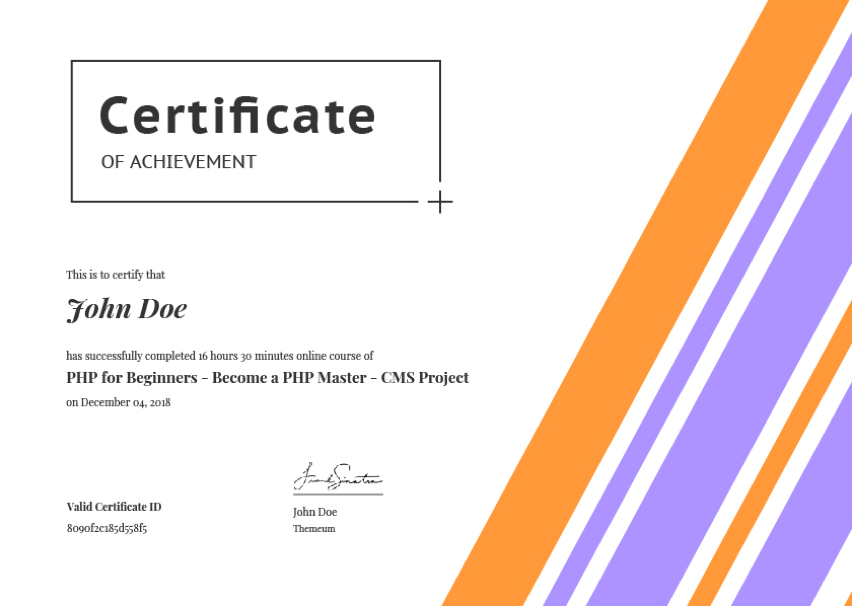
selected template
Scroll to Top